Electro-magnetic attempt to visualise forces using material memory
2 COMPARATIVE EXPERIMENTS
Account of a Magnetically Driven System with Material Memory and Adaptive Feedback
This experiment was developed to explore how magnetic forces interact with matter over time, and in particular how material systems retain traces of past interactions rather than rapidly responding to changing conditions. Rather than attempting to use magnetism as a static phenomenon, the setup was designed to slow it down, spatialise it, and place it in an adaptive feedback relationship
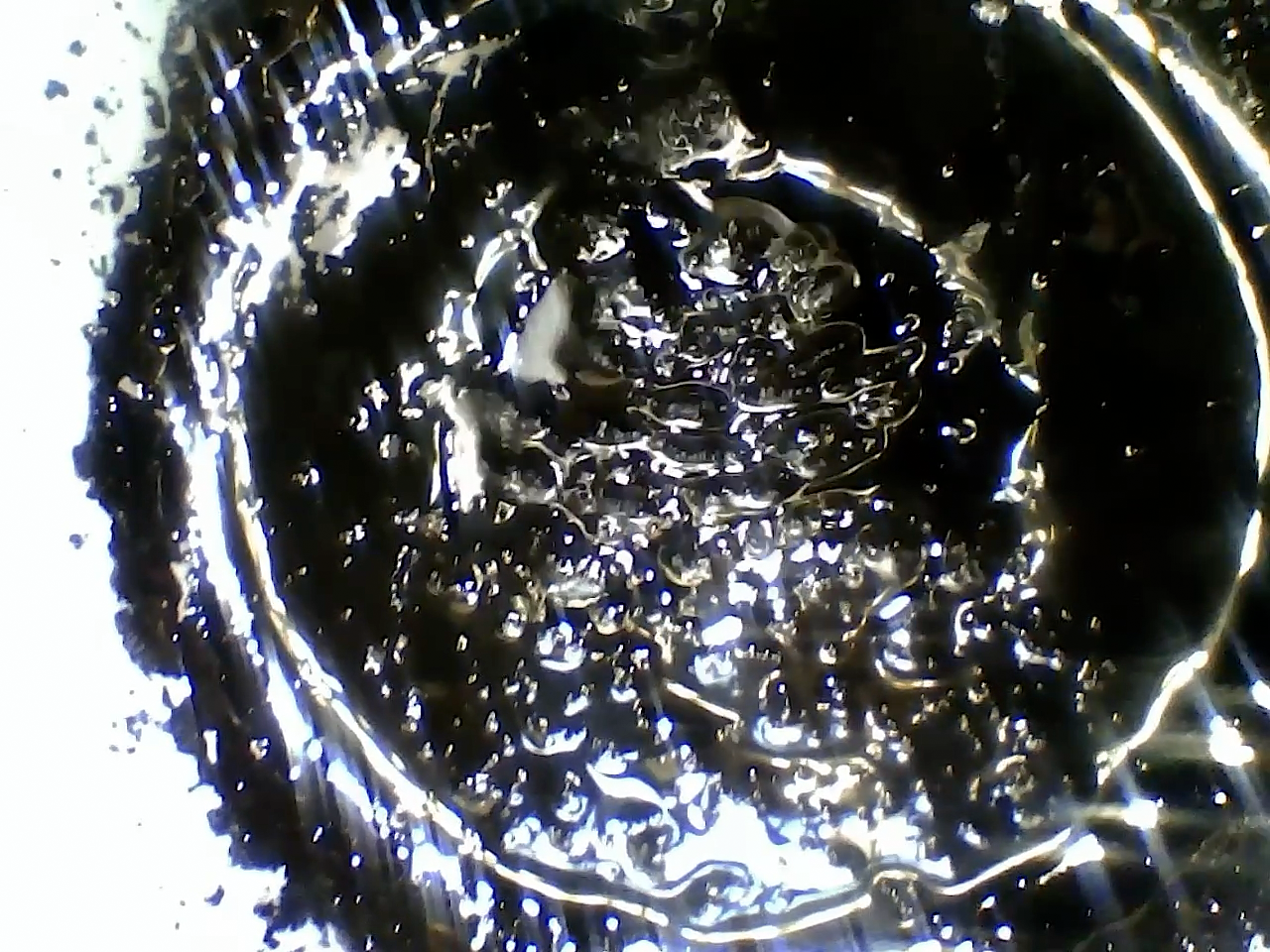
The system consists of a small Erlenmeyer flask filled with mineral oil, in it a very small amount of iron filings are suspended. Beneath the flask, a magnetic stirrer generates a rotating magnetic field whose speed can be adjusted. The oil serves to introduce viscosity and delay (a memory), preventing the filings from snapping instantly into alignment. The oil allows chains, vortices, and clusters to form gradually. A camera mounted above the vessel captures the evolving patterns of motion and aggregation.
The video feed is processed in real time to extract low-dimensional features describing the system’s current state—such as overall motion intensity, directional bias, texture, and structural coherence. These features, along with delayed versions of themselves and recent control values, are provided as input to a spatial encoder neural network (SE_NN).
When the magnetic field is applied, the filings begin to align and aggregate, but not uniformly. Structures form, break, and reform, lagging behind changes in the driving signal. When the field is slowed or stopped the system does not return to a prior neutral state. Instead, previously formed structures persist, biasing subsequent motion and leading to different outcomes for identical inputs depending on the system’s recent history. This history dependence is not treated as noise or error, but as the primary goal of this experiment.
Across repeated runs, the system exhibits consistent tendencies but never identical trajectories. The SE_NN does not converge on a single stable control strategy; instead, it adapts to the material’s ongoing resistance, memory and delay. Observation, interpretation, and intervention become mutually entangled.
The experiment does not aim to prove viscous memory as a physical law, nor to optimise control in the engineering sense. Instead, it demonstrates how memory can reside in matter itself, and how learning systems can negotiate that memory rather than override it. Knowledge here is produced operationally: through sustained interaction, adjustment, and response, rather than through detachment, objectivity or final verification.
Seen this way, the system functions as a second-order cybernetic loop in which material processes, computational learning, and human design decisions co-determine one another. What emerges is not a single result, but a field of behaviours that visualise the limits of objectivity and the necessity of participation when dealing with systems that remember.
Blob tracking of the viscous material for analysis with an artificial neural network.
Experiment B.
Account of a Comparative Experiment Using Ferrofluid Under Magnetic Control

In contrast to the iron-filings-in-oil system, a second experiment was conducted using a commercially available ferrofluid: a suspension of nanoscale magnetic particles stabilised within a carrier liquid. The experiment was designed not to amplify memory, but to observe what happens when magnetic matter is engineered to minimise memory and resist remanent structure.
The ferrofluid was placed in a similar flask above the same magnetic stirrer used previously, allowing for direct comparison of magnetic actuation. When the rotating magnetic field was applied, the fluid responded immediately and coherently. Rather than forming discrete chains or lagging structures, the surface of the ferrofluid reorganised smoothly, producing spikes and ridges characteristic of magnetic surface instabilities. Changes in speed or direction of the field resulted in near-instantaneous reconfiguration of these forms. The viscous memory was absent.
Unlike the iron filings, the ferrofluid showed little evidence of persistence once the field was altered or removed. Structures collapsed rapidly, and repeated parameter sweeps produced highly similar outcomes. Identical inputs yielded nearly identical configurations, regardless of prior states. The system exhibited reversibility rather than path dependence, and delay appeared primarily as fluid inertia rather than material memory.
When coupled to the same camera-based analysis and adaptive control system, the SE_NN quickly learned stable mappings between observed surface features and control parameters. Unlike the filings system, where the network was forced to continuously adapt to lingering material states, the ferrofluid system encouraged convergence and predictability. The ferrofluid acted as if in a controlled loop.
This contrast makes explicit the difference between the two materials. Where the iron filings expose memory, resistance, and history as fundamental properties of matter, the ferrofluid exemplifies a modern engineering ideal: a material optimised for responsiveness, controllability, and forgetfulness. Memory is suppressed at the scale of particles; magnetism becomes morphology without duration.
Taken together, the two experiments reveal that viscous memory is not an inevitable feature of magnetic systems, but a contingent one—emerging where discreteness, friction, and imperfect coupling are allowed to persist. The ferrofluid does not contradict the first experiment; it clarifies it by showing that if we remove control from matter, memory appears.
Part of a series of ‘experiments after objectivity’.
 Jerry Galle