Drugging the data.
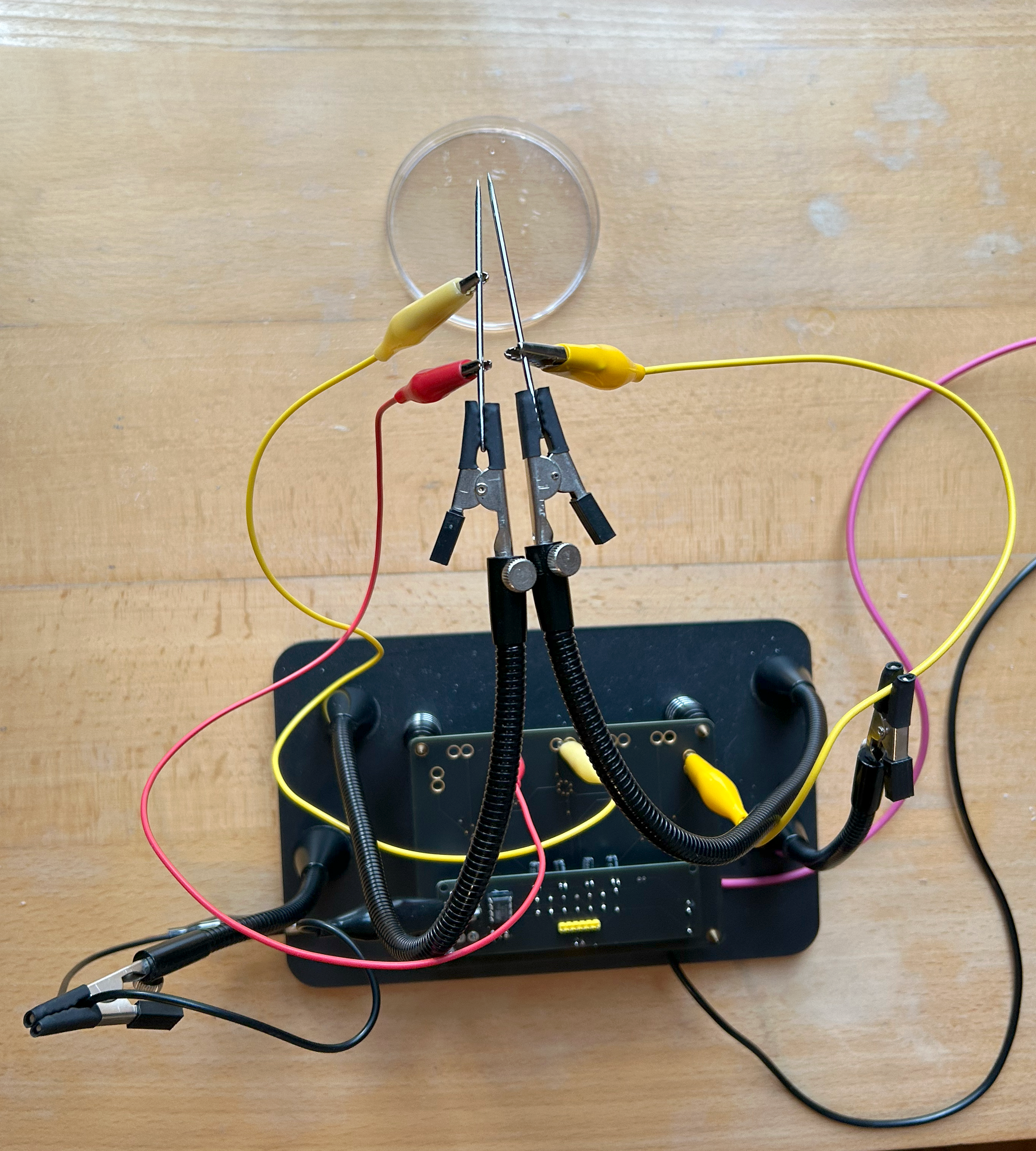
The liquid conduit device.

Butterfly Pea (Blue Clitoria Ternatea)
With this project electric transmission is intercepted by single drops of salted water and in a later stage with added Butterfly Pea. The addition of salt renders the water conductive, but also introduces variability: conductivity fluctuates with concentration, evaporation, temperature, and the micro-geometry of each drop. Added Butterfly Pea infusion further complicates this process. Butterfly Pea is traditionally used as a cognitive and circulatory tonic, known for its vivid blue pigments that respond visibly to changes in pH. Within the project, this responsiveness becomes diagnostic: the liquid not only carries electrical potential but reveals its interaction through chromatic and chemical shifts. The drop is simultaneously conduit, sensor, and indicator.
The liquid conduit experiment doesn’t simply weaken a signal—it transforms it. It reacts to what passes through it, briefly remembers that interaction, and actively reshapes what follows. In this sense, the medium is not neutral. It participates.
Machines depend on clarity, stable thresholds, and clean signals. Yet something as mundane as a drop of salty water is enough to make a system behave differently—or maybe let it fail entirely. This fragility exposes something, that technical systems are never fully sealed from the material world wherein they reside.
Cybernetics embraces this condition. Unlike conventional science, which strives to render everything knowable, cybernetics operates in the unknowable. It studies how systems function without complete knowledge of their environment or themselves. In this way, its world view aligns with ’pataphysics: both reject the illusion that reality can be exhausted by rational description alone and instead engage with paradox, exception, and instability as positives.
Neither computation nor organic growth can be totally efficient: computation generates heat, which has to go somewhere, and not every atom that enters a system can become a functional part of it. Since matter and energy cannot be destroyed, an organism must therefore shed both, existing not as a closed object but as a dynamical pattern that can only persist within the flux of a larger environment. For this reason, such systems cannot be achieved through mere mechanical mimicry but require working alongside the material complexity of natural processes, where even electric potential becomes correlated with cognitive activity.
Liquid Conduit can be understood as a medicinal apparatus: a system that does not only transmit information, but administers it. Electricity enters the work not as a neutral carrier of data, but as a raw potential that must pass through liquid matter—through droplets that dilute, delay, absorb, and transform it. In this sense, information is not passed but drugged. The liquid does not function as a passive conduit; it metabolises the signal, altering its intensity, rhythm, and expressive capacity in ways analogous to how a drug interacts with a body.
Like any medicine, the process is inherently inefficient and side-effect–laden. Energy is lost as heat, signals leak, distort, and precipitate. These losses are not errors but conditions: they slow transmission and introduce latency. The droplets act as micro-dosages, breaking continuous electrical flow into discrete events suggesting a pharmacokinetics of information in which timing, concentration, and medium matter as much as the original data transmission.
The system aligns with biological processes in which electric potential correlates with cognitive and metabolic activity, and where meaning emerges not from perfect transmission but from interaction, resistance, and transformation.
Setup experiment 1
- Liquid_Conduit software converts images (data) into audio signals.
- These encoded audio signals are sent via mono output to the Liquid Conduit device.
- A single drop of salted water falls between the electrodes, intercepting and transforming the signal.
- The resulting audio is fed back into the Liquid_Conduit software.
- This altered signal is then used to adapt the original image data to interface with the liquid drip, drip, drip.
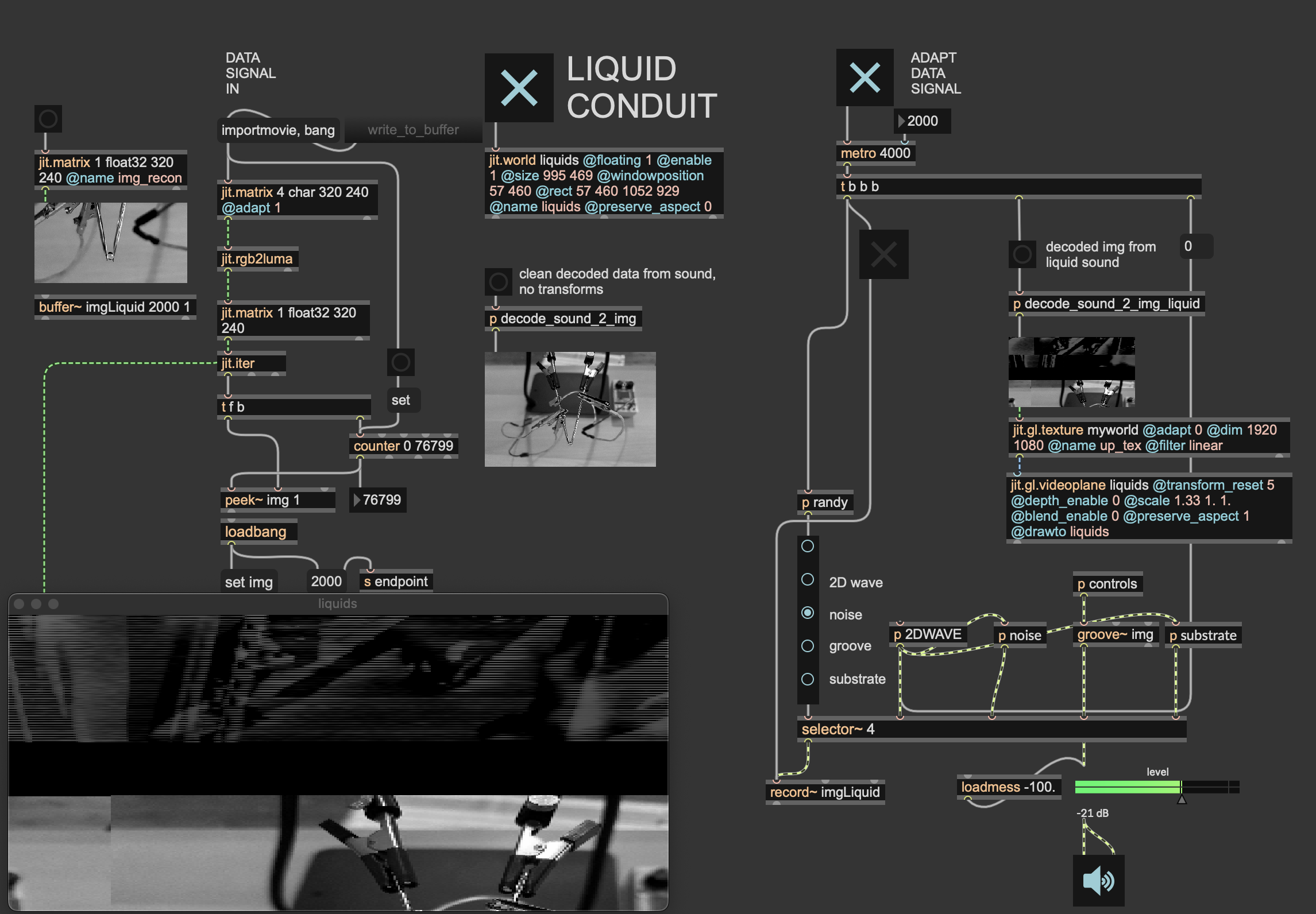
Screenshot Liquid Conduit software in Max Msp
Setup experiment 2 (audio only)
- Audio signals from a modular synth are send to the Liquid Conduit device.
- A single drop of salted water falls between the electrodes, intercepting and transforming the signal.
- The resulting audio is fed back into the audio mix as feedback signals.
- This altered signal is then used to adapt the original audio to interface with the liquid drip, drip, drip.
GOALS experiment 1 & 2:
Unlike a usual copper wire—which is fast, stable, and nearly lossless—this setup renders the connection:
Dispersive: different frequencies propagate at different speeds through the droplet, separating in time and phase as they move through ionic liquid rather than crystalline metal.
Non-linear: the system’s behaviour changes with salt concentration, droplet geometry, temperature, and the history of previous signals; past transmissions leave residual conditions that affect what can pass next.
Polarising: at each electrode–liquid interface, ions accumulate into microscopic charge layers, forming “ghost capacitors” that temporarily store and release charge, bending the signal in time.
Adaptive: the charge path continuously reorganises itself in response to the liquid’s shifting properties—size, shape, conductivity, evaporation rate, and chemical composition—so the conduit is never the same twice.
Viscous: transmission is slowed not only electrically but materially, shaped by surface tension, gravity, and the resistance of fluid movement.
Fragile: small disturbances—air currents, vibration, temperature—can radically alter connectivity, making the system sensitive to its environment.
Metabolic: energy is not merely passed along but partially consumed, transformed into heat, chemical change, and visible reaction.
Diagnostic: the liquid reveals the passage of electricity through visible shifts—movement, colour, or reaction—making transmission legible as a material event rather than an abstract one.
Together these qualities frame the setup not as a wire substitute, but as an interface: a conduit that behaves less like infrastructure and more like tissue.
 Jerry Galle